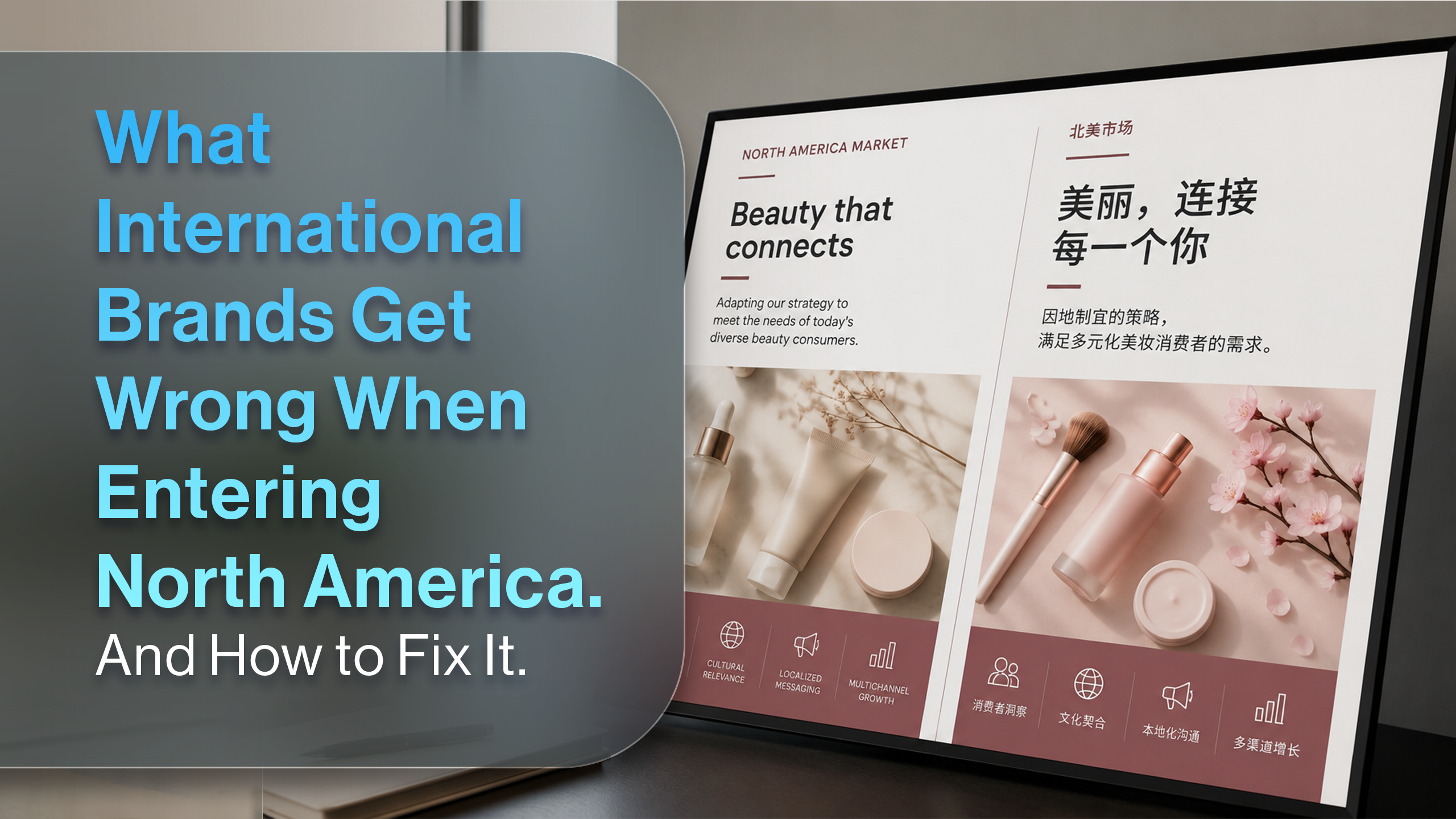
North America holds the largest share of the global direct selling market, built on mature distributor networks and early adoption of digital and social commerce. That scale is exactly why so many international brands, especially from Asia-Pacific and Latin America, see it as the natural next stop for growth.
But most international brands that try to enter North America do not fail because their product is wrong. They fail because their marketing strategy does not translate. This blog breaks down the most common mistakes international brands make when entering NAM, and what the brands getting it right are doing differently.

Why Is North America the Hardest Market for International Brands to Crack?
North America is not one market. It is three countries, fifty states, and dozens of regional cultures, shaped by different platforms, humor, and shopping habits. Content built for a home market rarely maps cleanly onto that.
English-language content alone is not enough either. The audience needs to feel understood, not marketed to, and that is a different skill than translation. A brand entering the US, Canada, and Mexico all at once is really entering three distinct markets that happen to share a continent, each with its own expectations for tone, proof, and trust.

What Gets Lost in Translation. And Why It Costs More Than You Think.
Lost in translation is not just a language problem. It is a brand voice problem, a cultural reference problem, and a trust problem. Over four in five consumers say they will not buy from a brand that does not offer support in their own language, and North American audiences are no exception. International brands often translate content literally and lose the emotional resonance that made it work at home.
The Most Common Translation Mistakes in Direct Selling Marketing
- Translating slogans word for word instead of adapting the underlying idea
- Reusing home-market imagery, colors, or references that read differently in NAM
- Assuming English content performs the same way in the US, Canada, and Mexico
- Skipping the compliance language direct selling claims require in a new market
How to Adapt Your Brand Voice Without Losing Your Brand Identity
The brands that get this right start with what the brand means, not what the brand says. They separate the message, whether that is empowerment, quality, or community, from the specific words used to express it, then rebuild that message in-market with input from people who actually live there. The identity carries over. The script does not.

Why Local Content Is the Highest-ROI Investment for Market Entry.
Once the message is right, the next question is who delivers it. Content that feels local, created by local voices and distributed on the right platforms for that market, consistently outperforms translated global campaigns.
What Local Content Actually Means in North America
- Built for the platform where that audience actually spends time, not repurposed from a home-market feed
- Created or co-created with people based in the market, not written centrally and translated
- Tested per country, since what lands in the US does not automatically land in Canada or Mexico
- Reviewed for compliance language specific to direct selling claims in each market
Why Micro-Creators Outperform Global Campaigns in New Markets
In 2026, micro-influencers are delivering significantly higher engagement rates than mega-influencers, often at a fraction of the cost per post. For a brand entering a new market with no existing audience, that combination of trust and efficiency matters more than raw reach.
BWL, a Singapore-based beauty and wellness brand, faced this exact challenge when it set out to build a North American audience from zero. Rather than translating its home-market campaigns, the brand rebuilt its BioSC Ampoule launch around a local, influencer-first strategy that used Canada as an entry point into the broader NAM market. See the full BWL BioSC Ampoule case study here.

How the NexLaunch Fractional Marketing Team Solves the Market Entry Problem.
A market entry this complex needs more than a translation vendor or a generic agency. It needs a team that understands both the brand and the destination market equally well. That is what a Fractional Marketing Team is built to do.
What Makes a Fractional Marketing Team Different From a Traditional Agency
- Senior-level bilingual strategists embedded in both the home brand and the destination market
- No ramp-up learning curve, since cultural context comes built in from day one
- A flexible team that scales with the brand’s stage, not a fixed retainer package
- Cultural intelligence built into the strategy itself, not bolted on after translation
The Services That Matter Most for International Market Entry
- Bilingual content strategy built for the brand voice, not a direct translation
- Local influencer sourcing and management in the destination market
- Paid media planning localized per country, not run as one blanket NAM campaign
- Compliance-aware copywriting for each market’s direct selling regulations
- North America is the largest, most established direct selling market in the world. The opportunity is real.
- Most international brands fail not because of their product, but because their message gets lost in translation.
- Local content created by local voices consistently outperforms translated global campaigns.
- The right partner understands both your brand and your destination market equally well.
- A Fractional Marketing Team gives you senior-level local strategy without building an entire internal team.
This month’s NexLaunch Connect newsletter covers how BWL built a North American presence from the ground up: How a Singapore Beauty Brand Built a North American Community From Zero. And What Your Brand Can Learn From It.
Subscribe: nexlaunch.com/blog
Ready to Enter North America Without Losing What Makes Your Brand Powerful?
NexLaunch is the fractional marketing team that helps international brands enter and grow in North America without losing what makes them powerful at home. We understand both the brand and the market. We create content in the right languages, for the right audiences, on the right platforms. We do not just translate. We connect.