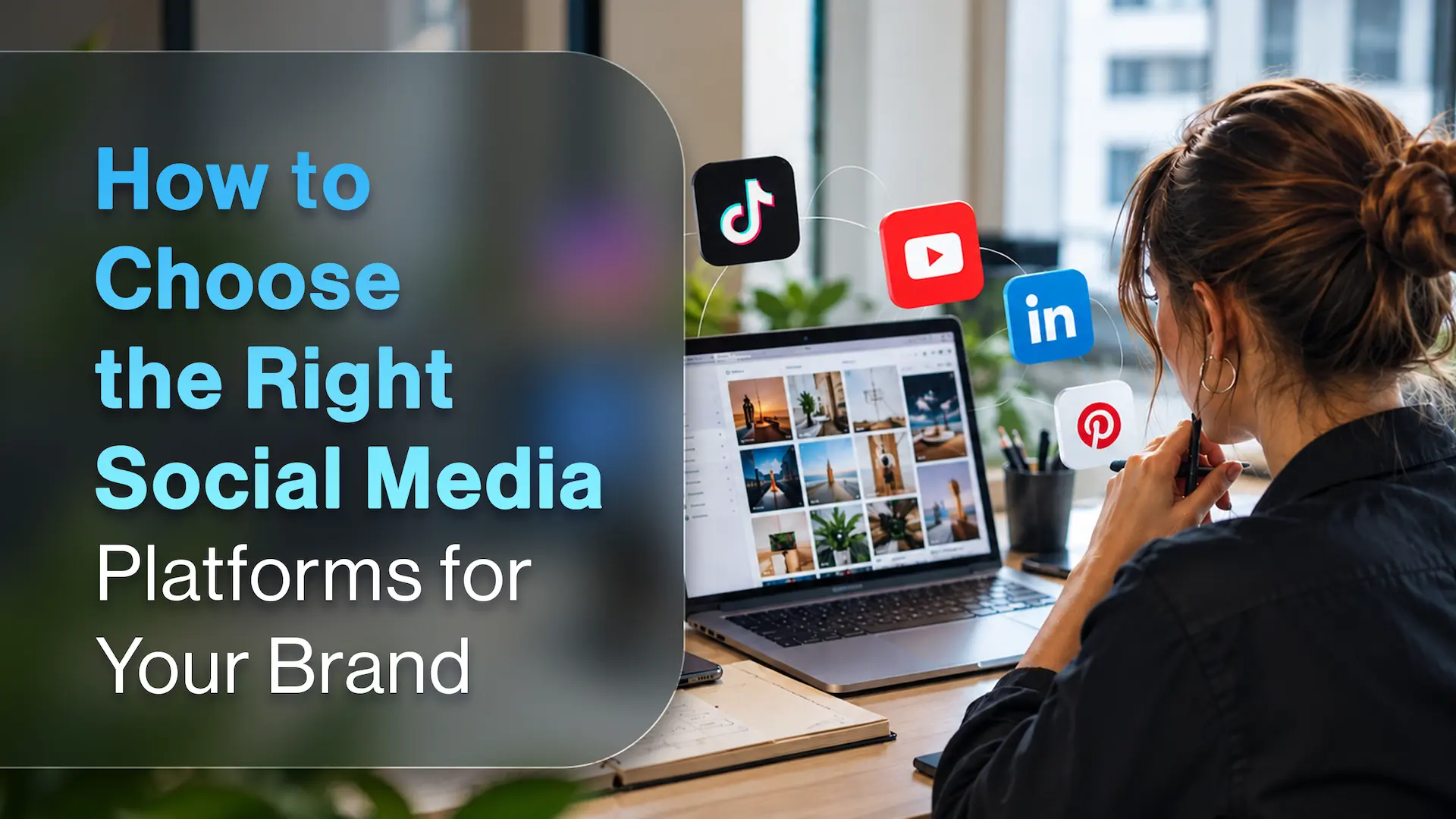
Your brand is on Instagram, Facebook, TikTok, and maybe LinkedIn. You are posting consistently. But the results do not match the effort, and you cannot point to a clear reason why.
The problem is usually not the content. It is the platform.
Most brands pick their social media channels based on where their competitors are, or wherever the latest trend is pointing. The result is a scattered presence that spreads budget and attention across platforms that were never the right fit to begin with. According to the Sprout Social 2026 Social Media Index, consumers plan to spend significantly more time on Facebook, Instagram, and YouTube than on any emerging platform in the near term. And yet, many brands are still chasing novelty over strategy.
This guide breaks down a practical framework for choosing the right platforms in 2026, based on data and built around your audience, your content capability, and your actual business goals.


Most Brands Are on the Wrong Platforms
Here is the honest truth: being on every platform is not a strategy. It is a distraction.
When a brand tries to maintain an active presence on six channels simultaneously without the team or budget to do it well, what happens is predictable: content gets recycled without adapting it to each platform, posting schedules fall apart, and the audience never gets a reason to pay attention.
Social media ad spending continues to grow year over year, with global digital advertising investment projected to surpass $700 billion by 2025 according to Statista. That investment is wasted when it goes to the wrong channels.
The brands that are winning on social right now are not the ones posting the most. They are the ones who chose the right two or three platforms, showed up with consistency, and built content that matched what each platform is actually designed for.
What the 2026 Data Actually Says
The Sprout Social 2026 Social Media Index highlights a pattern that marketers cannot afford to ignore: there is a clear gap between where brands are investing and where consumers are actually spending time and making purchase decisions.
Key findings for brand strategy in 2026:
- Facebook, Instagram, and YouTube remain the top platforms where consumers plan to increase their time, well ahead of newer entrants.
- Short-form video under 60 seconds is the highest-performing content format across all major platforms.
- Consumers use different platforms for very different purposes. Instagram and TikTok drive discovery. Facebook drives community and retargeting. YouTube builds long-term brand authority.
- Purchase decisions increasingly happen after multiple touchpoints across two or three platforms, not just one.
What this means for your brand is simple: the platform you choose needs to match where your audience is at the moment they are ready to engage, not just where they spend the most total time.
The Platform Selection Framework
Before you add or drop a platform, run it through these four questions:
- Where is your audience?
Not where you assume they are. Where does the data say they spend time? Look at your analytics, your customer demographics, and any research specific to your industry or category.
- What type of content can you actually produce consistently?
TikTok and Instagram Reels require short-form video. LinkedIn rewards long-form thought leadership. Pinterest is built around evergreen visual content. If your team cannot produce short video reliably, TikTok is the wrong starting point.
- What is the role of social in your sales funnel?
Are you trying to build awareness, generate leads, or drive direct purchase? Each platform serves a different part of the funnel better than others. Instagram and TikTok are top-of-funnel discovery engines. Facebook is strong for retargeting and community. YouTube builds long-term consideration.
- What does success look like in 90 days?
Platform selection without a measurable goal is just preference. Define what winning looks like: follower growth, engagement rate, website traffic, lead volume, or direct sales.

A Quick Look at Each Major Platform
Here is a simplified breakdown of what each platform does well in 2026, so you can match your goals to the right channel:
Facebook: Community building, retargeting, paid ads, local business. Still the largest global network by active users. Strong for direct selling brands with an established customer base.
Instagram: Visual brand identity, product discovery, Reels for organic reach. Best for brands with strong visual assets and a consistent aesthetic.
TikTok: Short-form video discovery, creator partnerships, younger demographics. High organic reach potential but requires a consistent video production cadence.
YouTube: Long-form authority content, tutorials, brand storytelling, evergreen SEO. Best for brands with educational content or product demonstrations.
LinkedIn: B2B, thought leadership, professional services. Not the right fit for most consumer or direct selling brands unless targeting distributor recruitment.
Pinterest: Evergreen visual content, home, food, beauty, lifestyle. Drives long-term traffic but requires a strong library of high-quality images.
X (Twitter): Real-time conversation, trending topics, brand voice, and industry commentary. Best for brands that have a strong point of view and can publish consistently at a high cadence. Effective for direct-to-consumer brands building community and cultural relevance.
The Execution Gap: Why Strategy Alone Is Not Enough
Choosing the right platforms is only half of the equation.
The execution gap is where most brands stall. They identify the right channels, build a content plan, and then fall short on delivery because they do not have the creative capacity to produce platform-specific content at the volume and quality each channel requires.
Platform-specific content is not the same as repurposing. A blog post turned into a caption is not an Instagram strategy. A square graphic resized for Stories is not a TikTok. Each platform has its own language, format, pacing, and audience expectation.
This is where having the right team makes the difference. NexLaunch’s Social Media Management service is built around platform-specific strategy and execution. Not templates applied across channels, but content built for each one from the ground up.
For brands that also need ongoing creative assets their field and their team can actually use, the Fractional Creative Team service handles production on demand, from day one.
How to Audit Your Current Platform Mix
If you are already active on social media and want to evaluate whether you are on the right platforms, start here:
- Pull your last 90 days of analytics for each platform. Where are you seeing the highest reach, engagement, and click-through? Where are you posting and getting nothing back?
- Map each platform to a funnel stage. Is this channel generating awareness, nurturing consideration, or driving conversion? If you cannot answer that question for a platform, you may not have a strategy for it yet.
- Evaluate your content output honestly. Are you producing content that is actually built for each platform, or are you recycling the same assets everywhere? If it is the latter, that is the first thing to fix.
- Look at where your competitors are winning, not just where they are present. A competitor with 50,000 followers on Instagram but 2% engagement is not winning on Instagram. Find where their audience is actually responding.
- Set a 90-day experiment. Pick one platform to focus on with intentional, platform-specific content. Measure the results against your baseline. Let the data guide the decision.

Choosing Platforms Is Step One. Executing Is Step Two.
The social media landscape in 2026 does not reward presence. It rewards relevance.
Being on the right platforms with content that is built for each one, produced consistently, and measured against real business goals is what separates the brands that grow on social from the ones that just post.
The framework in this guide gives you the foundation. But the gap between knowing which platforms to choose and building a strategy that actually performs on each one is where most brands need support.
This month’s NexLaunch Connect newsletter covers the platform selection framework every brand needs to know in 2026. Subscribe to NexLaunch Connect.
If you are ready to build a platform strategy backed by data and executed by a senior team, schedule a strategy call with NexLaunch.